
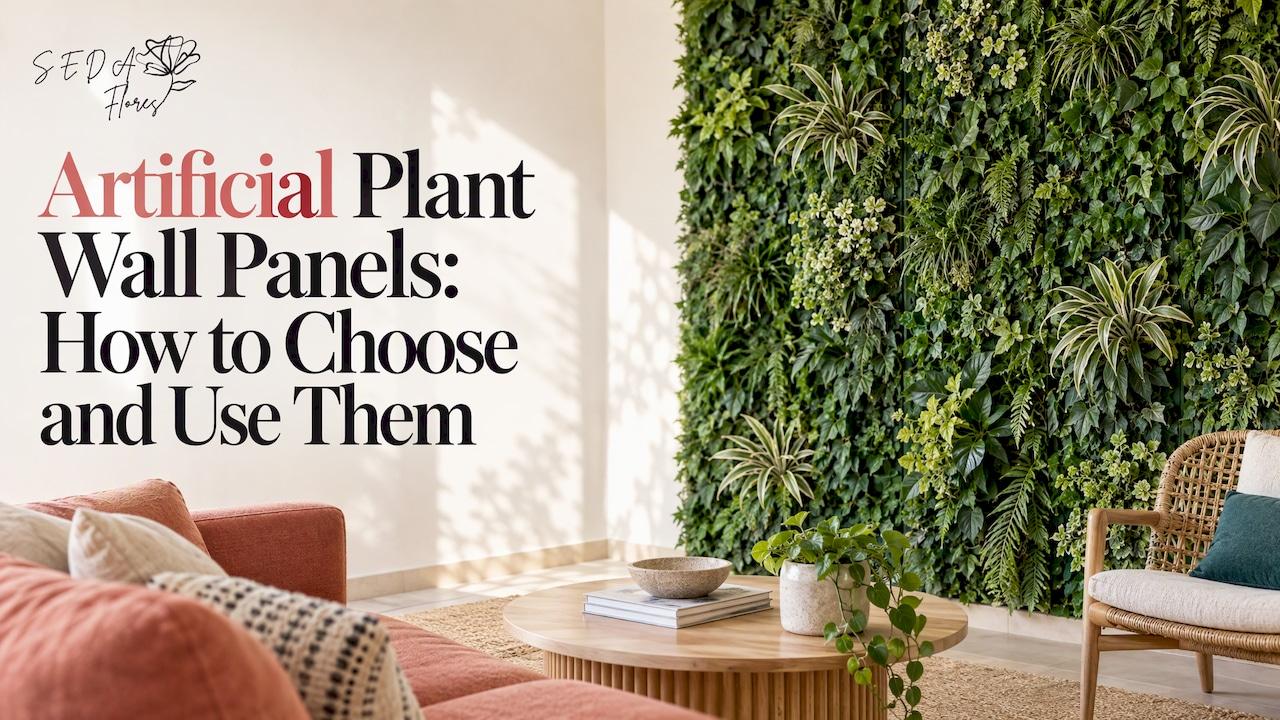
Artificial plant wall panels are modular tiles of faux foliage, usually boxwood, ivy, fern or mixed leaves, that you fix to a wall to get a full green surface with no watering, pruning or plumbing. They work best when the panel suits the room, the light and the wall behind it, and when the whole wall is designed as one composition rather than a stack of identical squares. That design step is where we come in: at Seda Flores, Esther creates bespoke arrangements and custom installations, including flower and plant walls and facades, tailored to your style, space and budget.
Below you will find what panels are made of, how to judge realism, what "UV resistant" really promises, which fire rating matters in a business, how panels go up on a wall and how to keep them looking fresh.
TL;DR
- Artificial plant wall panels are modular foliage tiles that give you a green wall with no living plants to support, water or replace.
- Realism comes from varied leaf shapes and tones, layered depth and a clean edge, not from the number of leaves per square foot.
- For sunny patios, balconies and facades, look for UV-stabilized foliage; for commercial interiors, ask about the flame-spread class before you buy.
- Panels go up fastest on a flat, clean, dry wall with a backing board or frame, and a custom installation hides every joint.
- Cleaning is a light dusting a few times a year, and shade or sun protection does most of the work against fading.
Table of Contents
- What artificial plant wall panels are, and how they differ from a living wall
- Where panels work best
- How to choose panels that look real
- Materials, backing and sizes
- Using panels outdoors: what UV resistance means
- Fire ratings for business and event spaces
- Installing panels on different walls
- Cleaning and keeping panels fresh
- A wall designed for your space
- FAQ
- Sources
What artificial plant wall panels are, and how they differ from a living wall
A panel is a square or rectangle, commonly around 20 by 20 inches, with synthetic leaves attached to a backing grid. Panels interlock or sit side by side, so a wall of any size is built from repeating units. Shoppers also call them faux greenery wall panels or fake vertical garden panels. It is the same product.
A living vertical garden is a different system altogether. A 2025 academic review of vertical greenery systems treats them as designed structures in which mechanical support and plant selection both have to work, because the wall must sustain real plants. A faux panel skips that engineering. It is decoration with a green surface, so it behaves like any other wall finish: you hang it once and it looks the same next season.
That is why panels suit the people who ask us most about them:
- Homeowners who want a feature wall in a living room, entryway or home office.
- Vacation property owners whose house sits empty for weeks and cannot depend on anyone watering.
- Businesses that want a reception wall, restaurant backdrop or shop-front that looks the same in January and in July.
- Event planners who need a backdrop that can be built quickly and photographed well.
Where panels work best
In the home
The most popular spots are behind a sofa, beside a dining table, in a stairwell, and around a TV wall. Green is a calming color, and a full wall of foliage adds texture without taking floor space. Bathrooms with good ventilation and dim corridors, where real plants would struggle for light, are natural fits too.
In vacation properties
A holiday home faces two problems: long empty spells and strong sun. A wall of foliage on a covered terrace or in a hallway stays green without a watering schedule. On the Costa Blanca, where we are based, the combination of intense sun and salt air is exactly why we choose products for realistic appearance and long-lasting use in the Spanish climate. Our UV-resistant artificial plants are made for this kind of exposure.
In businesses
Reception areas, hotel lobbies, cafés, clinics and showrooms use green walls to soften hard architecture and to brand a space. Here the wall is seen by hundreds of people, so consistency matters: no brown patches, no gaps, no dead plants to swap out. Commercial spaces also bring fire-safety questions, covered below.
At events
Weddings, launches and pop-up stores use panels as photo backdrops, bar fronts and entrance arches. Flowers can be woven into the greenery to add a color story. Because panels are modular, a wall can be built, dismantled and reused.

How to choose panels that look real
Photos on a product page flatter everything. Judge the panel the way a designer judges it, in person or from close detail shots.
- Leaf variety. Real hedges are not uniform. Look for panels that mix leaf sizes and two or three shades of green, including lighter new growth at the tips. A single flat green screams plastic.
- Leaf finish. Glossy leaves reflect light and look artificial under spotlights. A matte or lightly textured surface reads as natural.
- Depth. Foliage should sit in layers, with some leaves forward and some recessed, so shadows fall between them. A flat sheet of leaves glued to a mat looks like wallpaper.
- Visible backing. Turn the panel in your mind and ask what shows at the edges and between tiles. A dark grid is easy to hide; a white or shiny backing is not.
- Plant type for the room. Boxwood gives a formal, clipped look. Ivy and trailing leaves feel softer and more romantic. Ferns and mixed tropical leaves suit a relaxed living space. Eucalyptus and olive tones fit Mediterranean interiors.
- Scale. In a small room, a smaller leaf reads as more refined. In a big lobby, larger, bolder foliage keeps the wall from looking busy.
Our own guide to what separates a high-quality artificial plant from a cheap one covers the same eye test in eight points, and our myths and facts about silk flowers and artificial plants clears up common misconceptions.
Materials, backing and sizes
Most panels combine three layers.
- Foliage: polyethylene (PE) or polyester fabric leaves. PE tends to look more three-dimensional and is the usual choice for outdoor panels, while fabric leaves give a softer look indoors.
- Stems and attachment: leaves are inserted or glued into a mesh, grid or plastic sheet.
- Backing: a plastic grid, a mesh mat, or in premium pieces a rigid board or metal frame.
Size affects both coverage and how the wall looks. A common tile of 20 by 20 inches covers about 2.8 square feet, so a wall of 10 by 8 feet needs roughly 29 tiles before you allow for cutting and waste. Larger formats mean fewer seams, which is an advantage on a big wall because every joint is a place where the eye can find a line.
| Wall goal | Good panel approach | Why |
|---|---|---|
| Small accent behind a sofa | Small tiles in mixed greens | Easy to fit around furniture and outlets |
| Full feature wall | Large tiles or a custom-built wall | Fewer visible seams |
| Reception or restaurant backdrop | Dense foliage with a dark backing | Looks full from every angle |
| Terrace or facade | UV-stabilized foliage on a fixed frame | Resists sun and wind |
| Event backdrop | Lightweight modular tiles | Fast to build and take down |
Using panels outdoors: what UV resistance means
Sunlight is what bleaches artificial foliage. Ultraviolet (UV) light breaks down the pigments and the plastic itself, so leaves lose color and turn brittle. UV-resistant products add stabilizers to the plastic to slow that process. The word "resistant" means slower fading, not immunity, and no panel stays identical forever in direct, all-day sun.
Practical rules for an outdoor or semi-outdoor green wall:
- Give it some shelter where you can. A pergola, awning or overhang cuts the dose of direct sun dramatically.
- Fix it firmly. Wind turns a loose panel into a sail. Use a frame or backing board and fasteners suited to the surface.
- Allow for drainage. Rain should run off, not pool behind the panel, so avoid sealed backing against a wall that stays damp.
- Match the foliage to the weather. Rigid, UV-treated leaves such as cypress, olive and yucca hold their shape in heat better than delicate silk blossoms.
We sell UV-resistant pieces such as the cypress in 150 cm, yucca plants and olive trees, which pair well with a green wall to give a terrace layers of height in front of flat foliage.
Fire ratings for business and event spaces
Homeowners can skip this section. If you are covering a wall in a public building, restaurant, hotel or office, read it.
In the US, interior wall finishes are commonly classified by a test called ASTM E84, which measures how fast flames spread across a surface and how much smoke it produces. Under this system, Class A means a flame spread index of 0 to 25, Class B is 26 to 75 and Class C is 76 to 200, with smoke development capped at 450 for all three. Which class a space needs depends on the building type, its sprinkler protection and local codes, and the final word belongs to the local fire marshal or building authority. The International Building Code sets out those interior-finish rules in its chapter on interior finishes.

If you manage a commercial space in the US, check with your local authority having jurisdiction before you specify any green wall, and ask for the flame-spread documentation to be matched to the products. If you are in Spain, rules differ, so the same step applies with the local building authority. When you commission a project from us, tell us the venue and its use, so the design starts from the right brief.
Installing panels on different walls
Installation looks simple, and on a small wall it is. The quality of the result comes from preparation and from how you handle the seams.
- Measure and plan the layout. Mark the wall, subtract doors, sockets and switches, and decide where the foliage starts and stops. Start from the center and work outward so the cut tiles land at the edges, where they are least visible.
- Prepare the surface. The wall must be clean, dry and flat. Remove loose paint, dust and grease. Damp walls need to be fixed first, because moisture behind a panel causes mold and failed adhesive.
- Choose a fixing method by surface.
- Drywall or plaster: screws into studs or wall anchors, or a lightweight batten frame.
- Brick or concrete: masonry anchors into a batten frame or directly through the backing grid.
- Fences and railings: cable ties or clips through the grid. This is the easiest method, but it shows the back of the panel from the other side.
- Rental walls: adhesive hooks and removable strips work only for the lightest tiles and are rarely strong enough for a full wall.
- Join the panels. Interlock or tie neighboring tiles so there is no visible gap. Pull leaves from one tile over the edge of the next so the seam disappears.
- Finish the edges. Trim to the wall, then add a frame, a skirting detail or a ledge of plants and pots to give the wall a clean border.
- Step back and fluff. Bend leaves forward, fill thin patches and check the wall from where people will actually see it.
On a large wall, a facade or a ceiling, the work goes beyond what tiles and cable ties can do: structure, load, height and weather all matter. Our custom installations cover flower and plant walls, facades and artificial trees for homes and commercial spaces, so one person designs the composition, matches it to the room and takes care of the details that make a wall look built-in rather than stuck on.
Cleaning and keeping panels fresh
Artificial foliage needs very little, but not nothing.
- Dust: go over the wall every few weeks with a soft brush, a feather duster, or a hair dryer on a cool setting. Dust is what makes faux plants look fake after a year.
- Marks: wipe the leaf with a damp microfiber cloth and mild soap, then let it dry.
- Outdoor panels: rinse with a garden hose a few times a season, especially in dusty or salty coastal air.
- Fading: limit it by keeping the wall out of the harshest direct sun where possible and by choosing UV-stabilized foliage for any exposed position.
- Kitchens: grease collects on foliage near a cooking area, so place the wall away from the hob or plan to wipe it more often.
Because nothing grows, nothing needs replacing on a schedule. If one section is damaged, you replace a single tile instead of a whole wall.
A wall designed for your space
Panels from a catalog give you a green wall. A designed wall gives you the one that fits your room. At Seda Flores, Esther works with you on the style, the space and the budget, choosing products for realistic appearance and long-lasting use in the Spanish climate. We offer online and showroom sales, bespoke bouquets and arrangements, and custom floral and plant installations such as artificial trees, flower ceilings, walls and facades for homes and commercial spaces.
If you want to see foliage and flowers in person, you can visit our showroom. To start a project, see how our installations and custom work come together.

To browse what goes into a green wall, start with our silk plants, silk flowers and pots, vases and accessories.
FAQ
Can artificial plant wall panels be used outside?
Yes, when the foliage is UV-stabilized and the panel is fixed to a frame or backing that handles wind and rain. UV resistance slows fading rather than stopping it, so a covered spot keeps the color longest. Our UV-resistant plants are made for sun-exposed terraces and gardens.
How many panels do I need for my wall?
Divide the wall area by the area of one tile. A 20 by 20 inch tile covers about 2.8 square feet, so a 10 by 8 foot wall needs roughly 29 tiles. Add a few extra for cutting and edges.
Do green wall panels need a fire rating?
For a home, usually not as a rule of thumb. For restaurants, hotels, offices and other public spaces, codes can require interior finishes to meet a flame-spread class such as ASTM E84 Class A or B. Your local fire marshal or building authority decides what applies to your venue.
How do I make a faux green wall look natural?
Mix leaf types and shades of green, choose matte foliage, hide the seams by overlapping leaves, and add depth with plants or pots in front. A custom-designed wall, like those Esther creates for our clients, is built around your room and light rather than around a standard tile.
Sources
- Mechanical structure, plant selection, and environmental review of vertical greenery systems (ScienceDirect, 2025)
- ASTM E84 standard test method and flame spread classes (Intertek)
- Chapter 8 Interior Finishes, 2015 International Building Code (ICC)